Viva Editions are books that inform, enlighten, and entertain. The very name, "Viva!", is celebratory. And while Viva Editions is a line of books that are as fun as they are informational, the intention behind Viva is very serious—these are books that are truly helpful and intended to enhance people's lives.


Friday, June 15, 2012

Excerpt of the Day: "The Gratitude Power Workbook" by Nina Lesowitz and Mary Beth Sammons


Building upon the best-selling Living Life as a Thank You, authors Nina Lesowitz and Mary Beth Sammons have developed a workbook to take readers through a process of self-transformation and personal growth.  Filled with life-changing practices and encouraging advice, The Gratitude Power Workbook provides readers with tried and true thank you techniques and practices but also allows them to take part in creating their own.

Take a peak:

Are you tired of walking around with a hole in your heart? Do you need more inspiration? Studies show—and experts counsel—that gratitude is a key component of our own happiness. People who are grateful about events and experiences from the past, who celebrate the triumphs instead of focusing on the losses or disappointments, tend to be more satisfied in the present. In her popular book The Secret, Rhonda Byrne writes, “With all that I have read and all that I have experienced in my own life using The Secret, the power of gratitude stands above everything else. If you do only one thing with the knowledge of the book, use gratitude until it becomes your way of life.”

The recent buzz surrounding the power of gratitude is overwhelmingly
positive. Jeffrey Zaslow, a columnist for the Wall Street Journal, recently wrote that there may be a positive by-product of the troubled economic times that followed the 2008 stock market dive: a decrease in the urge to complain. “People who still have jobs are finding reasons to be appreciative. It feels unseemly to complain about not getting a raise when your neighbor is unemployed,” he wrote. “Homeowners are unhappy that home values have fallen, but it’s a relief to avoid foreclosure.”

Indeed, in these times of economic woe, gratitude is popping up everywhere. Turn on the TV. We listened as a career coach on The Today Show advised job seekers to put the words “Thank you” in their job search tool kits, declaring that the key to distinguishing oneself from the masses is to send a thank-you note. Click onto Facebook and check out the gratitude groups, where hundreds of people log on each day to give thanks for everything from the sun rising that morning to their neighborhood dog parks. Cathy, of Greenville, South Carolina, wrote, “I am grateful for a bark park to take my dog-children to, so I picked up extra poop and trash this morning.” Mary from Philadelphia wrote, “I am so grateful for the beautiful snow outside.”

Gratitude floats our boats and moves us to do all kinds of things inspired by joy. Gratitude can help us transform our fears into courage, our anger into forgiveness, our isolation into belonging and another’s pain into healing. Saying “Thank you” every day will create feelings of love, compassion, and hope. But the fact is, the art of living—for that is what we speak about when we speak of gratitude—isn’t something that comes naturally to most people. Most of us need to work intentionally to increase the intensity, duration, and frequency of positive, grateful feelings— a daunting challenge indeed. But fear not, this workbook is here to help! Inside we have provided you with mindful meditations, hands-on exercises, profound practices, inspiring quotations, space for writing, thought-provoking questions, and even positive “power tools” that will help you build a more grateful life.

Wednesday, June 13, 2012

Excerpt of the Day: "The Inspired Life" by Susyn Reeve and Joan Breiner


In need of an inspiration pick-me-up?  Look no further!  Susyn Reeve and Joan Breiner’s The Inspired Life is filled with definitions, quotes, life stories, exercises, and meditations meant to open your mind to the creative potential in every moment of daily life.

Here’s an excerpt:

“Our Invitation to You”

There have been many names for and descriptions of the times we are living in. Some consider this to be a New Age, others the Age of Aquarius. To some it is the End Times with doomsday quickly approaching. Some believe the end of the Mayan calendar is simply an astronomical occurrence while others define it as the end of civilization as we know it; still others say while it marks an end, it is a gateway to a new beginning of peace and cooperation among all peoples.

Charles Dickens’s words from his classic novel continue to ring true today.

The worst of times: When watching and listening to news reports it becomes clear that there is currently much strife and cruelty in the world: war, genocide, ethnic cleansing, the stoning of women, which always amazes me since the ones hurling the stones were birthed through the bodies of women—their mothers. Economic conditions throughout the world are worse than they have been in decades. The divide between the rich and the poor widens daily as the middle class disappears. Children are starving throughout the world while the military budgets of nations get larger and larger. In the United States partisan politics is so focused on who is “right” and who is “wrong” that it seems that issues—even the role and purpose of government itself—get lost in the desire to win elections. Corporate greed and government scandals fill the airwaves and leaders are not trusted. News pundits weave stories of fear and terror as their nightly offering. Natural disasters seem to be rapidly increasing. Is the current recurrence of bedbugs a plague in our midst? Hate crimes based on gender, race, ethnicity, sexual orientation abound. Not only is there hatred among racial and ethnic groups throughout the world, families can’t even get along.

The best of times: Since the first photograph, the famous “Blue Marble,” in which Earth is in full view was taken on December 7, 1972, as the Apollo 17 crew left Earth’s orbit, there is no doubt that we are One—one humanity on one planet. Since that time, our inter-connectedness and inter-dependence has been made more and more evident through the Internet via Twitter, Facebook, and blogs, which offer instant access to social networks and worldwide communities (and playing a significant role in the call for democracy in the Middle East); the global economy and the resources and support that are readily offered, not only by governments, but also by people throughout the world within hours of reports of disasters. Advances in research have provided life-saving procedures and remedies. Educational opportunities abound. There is a global movement afoot honoring Mother Earth, our true home. Green industries are becoming mainstream. At the same time the evolution of consciousness continues with more and more people committing to live Gandhi’s words, “Be the change you wish to see in the world.” Individuals and groups are reaching across borders and boundaries in the name of peace. Women throughout the world are stepping forward committed to peace and our voices are growing and the fruits of these labors are being felt.

Katherine Woodward Thomas and Claire Zammit lead “Calling in the One” and “Feminine Power Mastery” tele-classes with thousands of participants representing more than fifty countries worldwide. In these programs, women and men in a community of support declare their commitment to live their inspired life visions, to be love made manifest in their relationships with themselves, their families, and their local and global communities.

Whatever you may believe, isn’t now the time to enrich your life by affirming and committing to your inspired life vision? At the very least, living your vision offers you the possibility of greater joy, fulfillment, and happiness. And, at best, as you put your stake in the ground for living a more peaceful and loving life, your consciousness generating your actions contributes to the collective consciousness of the Greater Field of Life, and love grows and peace expands for all.

Monday, June 11, 2012

Excerpt of the Day: "Lemons and Lavender" by Billee Sharp


Looking to save money and remain eco-friendly?  Meet Billee Sharp and her fabulous book Lemons and Lavender!  Packed with tips, recipes, and advice, this handy how-to will help you save the planet and your pocketbook.

Interested?  Here’s a peek of what’s inside:

Most of us are searching for the good life. What constitutes a “good life” is obviously subjective, but our quest to find happiness directs each of our lives in unexpected ways. When I think of personal happiness, security and fulfillment immediately come to mind. We all want the means to realize our hearts’ desires, but it is perhaps these desires that need to be reexamined. As a society, we’ve recently learned the hard way that we often want more than we can afford: our overextended credit system and failed subprime mortgage market have led our economy to a near collapse.

Twenty-first-century life affords us a unique perspective on the world we live in. We are hyperconnected to the rest of the globe, and we are all too aware of the ecological and economic crises that beset contemporary life. We can see that our daily actions have very real repercussions, and what we do as individuals shapes our world both literally and figuratively. We now have an opportunity to take our vision for humanity more seriously.

Slowly, we are acknowledging that the earth does not have the capacity to meet our unrepressed appetites, and that to end the destruction of our environment and the suffering of millions, we have to want less individually. 

Our emotional well-being is connected to how much money we have; while it is wretched and distracting not to have enough money to pay the bills, there are also pressures and worries that come with having plenty.

As Duane Elgin notes in his book Promise Ahead,

For many, the American Dream has become the soul’s nightmare.
Often, the price of affluence is inner alienation and emptiness. Not
surprisingly, polls show that a growing number of Americans are
seeking lives of greater simplicity as a way to rediscover the life of
the soul.

How do we adapt our life expectations accordingly? For me, the desirability of a $7,000 designer handbag evaporates when compared to the number of people that sum could feed. The carbon offsetting system—where individuals calculate their carbon expenditure and try to lower their carbon footprint—is an initiative that shows how seriously we take our situation.  Likewise, the growing support for fair-traded goods in commercial markets is evidence that mainstream society is beginning to show more compassion for the people who make and grow our food.

Quite literally, how we see the world has changed. In 1966, with the question “Why haven’t we seen a photograph of the whole earth yet?” Stewart Brand initiated a public campaign for NASA to release the satellite image of our planet from outer space. His argument was that the image would be a powerful symbol for humanity, and he was right. Our visualization of the world was changed with our access to this image, and this parallels the dramatic reconfigurations that have transformed Western society. We now have legislation that prohibits discrimination based on color, gender, and religion. Popular opinion and our evolving global consciousness give us hope that humankind can peacefully coexist with one another and with the earth.

Friday, June 8, 2012

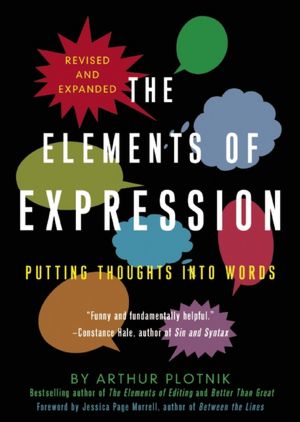
Excerpt of the Day: "The Elements of Expression" by Arthur Plotnik


Looking for a book on proper grammar?  The Elements of Expression isn’t it.  In a world of wikis, updated statuses, and texts, Arthur Plotnik takes language-users on a journey through expressiveness.  Humorous and witty, this book allows you—speakers, writers, and self-improvers—to take a fresh look at how you express yourself.

If that doesn’t interest you, maybe an excerpt will:

Something moves you to express your thoughts. The subject is love. Or beauty. Mortality. Some poignant experience.

You hesitate—and well you should. Launching ideas as messages is not exactly blowing kisses from a train. You are putting thoughts into words, which is more like flapping the tongue to escape gravity. We work our tongues endlessly, but liftoff is so rare it’s a miracle we don’t keel over like some NASA dud.

Yet we go on flapping rather than fall silent or simply moo at one another. We struggle with words because they separate us from the lowing beasts and tell the world who we are, what we want, and why. 

No one will dispute the need for verbal expression, because no one will sit still to listen. The need is assumed, but it is never more clearly illustrated than when Americans visit foreign lands of funny-speaking people. Even with a stock of their funny phrases we find it difficult to express our individuality. We barely distinguish ourselves from the wash jerking on the clotheslines. We feel like babies, unable to express the nuances of pleasure and discontent. And babies hate that feeling.

In foreign travel I often find myself, oh, about fifty thousand words short of being interesting to anyone but the local pickpockets. I remember one moody trip when, traveling alone, I dined night after night talking to my cheeses and such mistakenly ordered dishes as pickled cow’s face with hairy nostrils. One evening, a sensitive-looking young couple gestured for me to join them. We exchanged basic phrases, but what I wanted to express was an overflow of feeling, something like this:

My dear companionable saviors—For the last three weeks a shadow of melancholy has obscured my perceptions, dimming the beauty of your countryside and the conviviality of its inhabitants. Solitude, when no longer self-imposed, soon deepens into isolation and near madness.  Now, however, as your kind concern and sensitivity restore my spirit, all that I have perceived unscrolls and engulfs me in its majesty. I exalt in your land and its people.

What came out was the equivalent of “Me like here. Food good. Everything very good. You go America?”

They’d sat a three-year-old at their table.

Wednesday, June 6, 2012

Excerpt of the Day: "Use Your Words" by Kate Hopper


All you mommies and mommies-to-be with a passion for—or minuscule interest in—writing will love Kate Hopper’s Use Your Words.  This writing guide for mothers allows you the opportunity to grow as a writer, chapter-by-chapter, and leads you through the process of turning your motherhood story into art.

Here’s a little taste of what’s inside:

Reading about other mothers’ lives and experiences has expanded my world. To be able to walk in someone else’s shoes, whether it’s for a moment or an hour or a few days, is an incredible gift. I have gained insight into parenting and the human experience.

The stories I’ve read and listened to have ranged from light and funny to heartbreaking, and there is room for all of these stories as a part of motherhood literature.

In the introduction to their anthology Mothers: Twenty Stories of Contemporary Motherhood, Kathleen Hirsch and Katrina Kenison write, “It takes courage to write about motherhood in a culture that sets women with children on the sidelines, and it takes even greater courage to give voice to the powerful emotions and fears that swirl deep beneath the surface of our daily lives, informing and shaping our relationships with our children and the world at large.”

We all have stories to tell. Whether we tell these stories is another question. It does take courage to write about motherhood, to explore writing about our children and our roles as mothers, to “give voice to the emotions and fears that swirl deep beneath the surface” of our daily lives.

I hope this book will help give you the courage to get your mother stories down on paper. How often have you said, “Use your words!” to your children? How often have you heard other parents utter that phrase? Now it’s your turn. I designed this book to help guide you on your journey as a mother writer and help you find the most effective way to tell the stories you need to tell.

Monday, June 4, 2012

Excerpt of the Day: "Happily Even After" by Carole Brody Fleet


We’re excited to have Carole Brody Fleet visiting the office this Wednesday for our Twitter Party!  Interested in asking Carole your questions?  You can join us on Twitter between 3 and 4PM (PST), using the hashtag #happilybook.

You can also meet Carole at these Bay Area Locations!
6/6/12 11:00AM Towne Center Books, Pleasanton, CA
6/6/12 5:00-6:00PM Books Inc. Alameda, Alameda, CA
6/6/12 7:00PM A Great Good Place for Books, Oakland, CA
6/7/12 7:30PM East-West Bookshop, Mountain View, CA

Here’s an excerpt from Carole Brody Fleet’s book Happily Even After:

“Who am I?”

“What do I do now?”

As I lay on my couch the day after Mike’s funeral, in my stunningly attractive penguin-printed flannel pajamas with the feet in them, these two questions repeatedly turned over and over in my mind. They were burned into my brain; they were etched into my “soul with a hole.” Day after day, I continue to just lie there, pondering these two questions. I didn’t open the blinds. I’m not entirely sure that I ate anything. I just lay there thinking: “Who am I?” and “What do I do now?”

Not only are these understandably daunting questions, these are by far the two most frequently asked questions by widows. The funeral is over with and everyone has gone home and returned to their lives, yet for you, the reality of widowhood and the building of a new life has just begun. You are left without any sense of direction, and in many cases, without even a sense of self. You are simply left…alone.

You may be surprised to learn that the “What Now?” of widowhood isn’t limited to only those who have been recently widowed. You may have been widowed for quite awhile and feel as though you are still trapped in the “Who Am I?/What Do I Do Now?” phase of your Healing Journey, wanting oh-so-much to move forward and not having an inkling as to how to begin.

Let’s then examine the questions and concerns regarding the “beginning”—this most important part of your Healing Journey—as well as some of the ways that you can begin to slowly refocus and rebuild into a promising new life of your own. Whether your loss happened last week, last year, or last decade, let this very moment be a new start for you. It is time for your Widowtude Adjustment to begin.